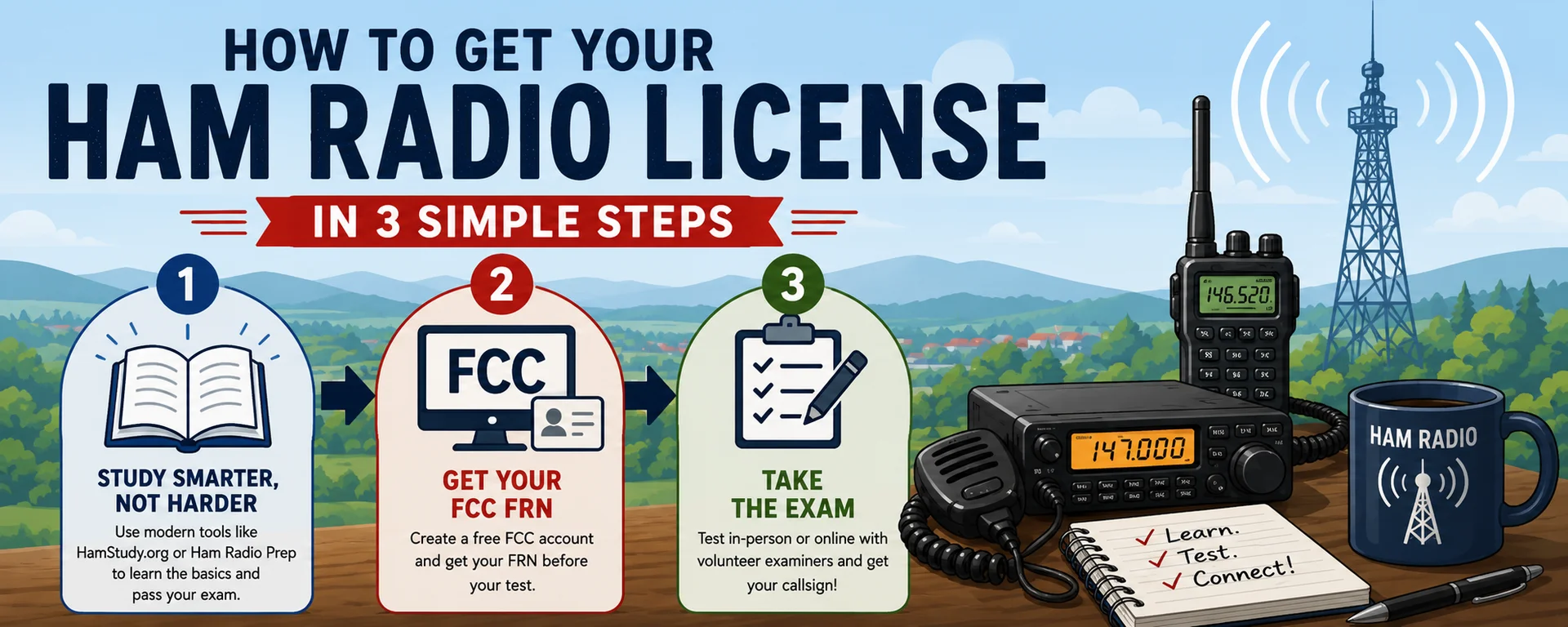
Have you ever wanted to jump on the local repeaters, get involved with storm spotting and other emergency communications, or experiment with wireless technology, but felt intimidated by the licensing process?
We have some good news: getting your amateur radio license is easier than you think. There is no Morse code test required, all exams are completely multiple-choice, and you can comfortably study for it in your spare time.
If you are ready to get your callsign and join the local radio community, here is the exact three-step roadmap to make it happen.
The 3-Step Roadmap
1. Study Smarter, Not Harder
The entry-level license is the Technician Class. The exam consists of 35 multiple-choice questions covering basic radio regulations, operations and equipment, basic radio and electronics theory, and safety guidelines.
You don't need to read a massive textbook. The fastest way to learn is by using modern, interactive tools:
HamStudy.org: A fantastic, free website and app that uses flashcards and tracks your progress.
Ham Radio Prep: Great if you prefer structured video lessons and quick quizzes.
2. Get Your FCC Registration Number (FRN)
Before you can sit for an exam, the FCC requires you to create a free account and get an FRN. This unique number identifies you in the FCC database so you don't have to write your Social Security number on an exam sheet.
Go to the FCC CORES website, register an account, and print out or save your FRN. You will need to bring this number with you to the test session.
3. Take the Exam
When you are ready, you'll take the test administered by a team of volunteer examiners. You have two options for how to test:
In-Person: Local radio clubs host regular testing sessions in a relaxed environment.
Online: If you can't make an in-person session, you can take a securely proctored exam online via your computer's webcam.
It’s completely normal to feel a little nervous before taking an exam, but knowing exactly how the session runs will help you walk in with confidence. The Volunteer Examiners (VEs) running the session are local hams from our community - they aren't drill sergeants, and they want you to pass!
Before arriving, be sure that you have writing utensils, your FRN and Photo ID, and a basic calculator. You can use a standard calculator, but the VEs may ask you to show that the memory is completely erased before the test starts. Note: You cannot use your phone's calculator app
When you arrive, you’ll sign in with the testing team. They will verify your ID and collect the test fee. You'll fill out a quick application form, and they will hand you your official 35-question multiple-choice test booklet and an answer sheet.
When you finish, you’ll hand your answer sheet back to the VEs. They grade the test right there in front of you. You will know whether you passed or failed within minutes of finishing.
If you pass, they will have you sign a Certificate of Successful Completion of Examination (CSCE) - this is your official proof that you nailed it while you wait for the FCC to issue your callsign!
What Does it Cost?
Amateur radio is an incredibly affordable hobby to enter. Here is the realistic breakdown of what you will look at spending to get licensed:
Study Material: Free (if using apps like HamStudy).
Exam Fee: Typically $15 paid to the volunteer testing team to cover administrative costs.
FCC Application Fee: $35. (Note: this will be paid directly to the FCC after successful completion of your exam)
💡 Passed your test? If you pass your Technician exam, most testing teams will let you try the next level up (General Class) right then and there for free. It never hurts to try!
Ready to Take the Leap?
We would love to welcome you to the airwaves. Our club hosts regular licensing exam sessions right here in the local area. We typically hold a test session before every monthly meeting. You can find more information here: https://nixahams.net/testing
If you have any questions or need an "Elmer" (ham radio talk for a mentor) to help guide you through a tough concept, drop a message or come hang out at our next club meeting!
K0NXA / 73
Logged by KE0JGH on July 11, 2026.
More from the log
View all →147.015 Transmit Power Update
On a whim, James, KB0NHX, went to check the power output on the 147.015 several days ago because it seemed weaker than usual in some areas and found it was only transmitting 40-Watts out of the duplexer. Previously, we drove the amplifier with 6.5 watts to get 225 Watts out.Thanks...
APRS Digipeater Update
Clayton, KB0WZI, and James, KB0NHX, made a trip to the K0NXA Digi site in South Springfield last Friday and Clayton found a few things that we think have gotten us rolling!First, the receive audio is controlled by the volume pot on the radio. It was turned down too low. In...
Crane Repeater Update
We have been able to confirm the problem at Crane is water in the coax cable. The good news is we have an abandoned run of 7/8” heliax running to the top of the tower. We have received a quote of $500 for a climber to come to the site,...